
Epoxy or Polyaspartic: Which One Lasts Longer in Quebec
July 15, 2026 · 4 min read
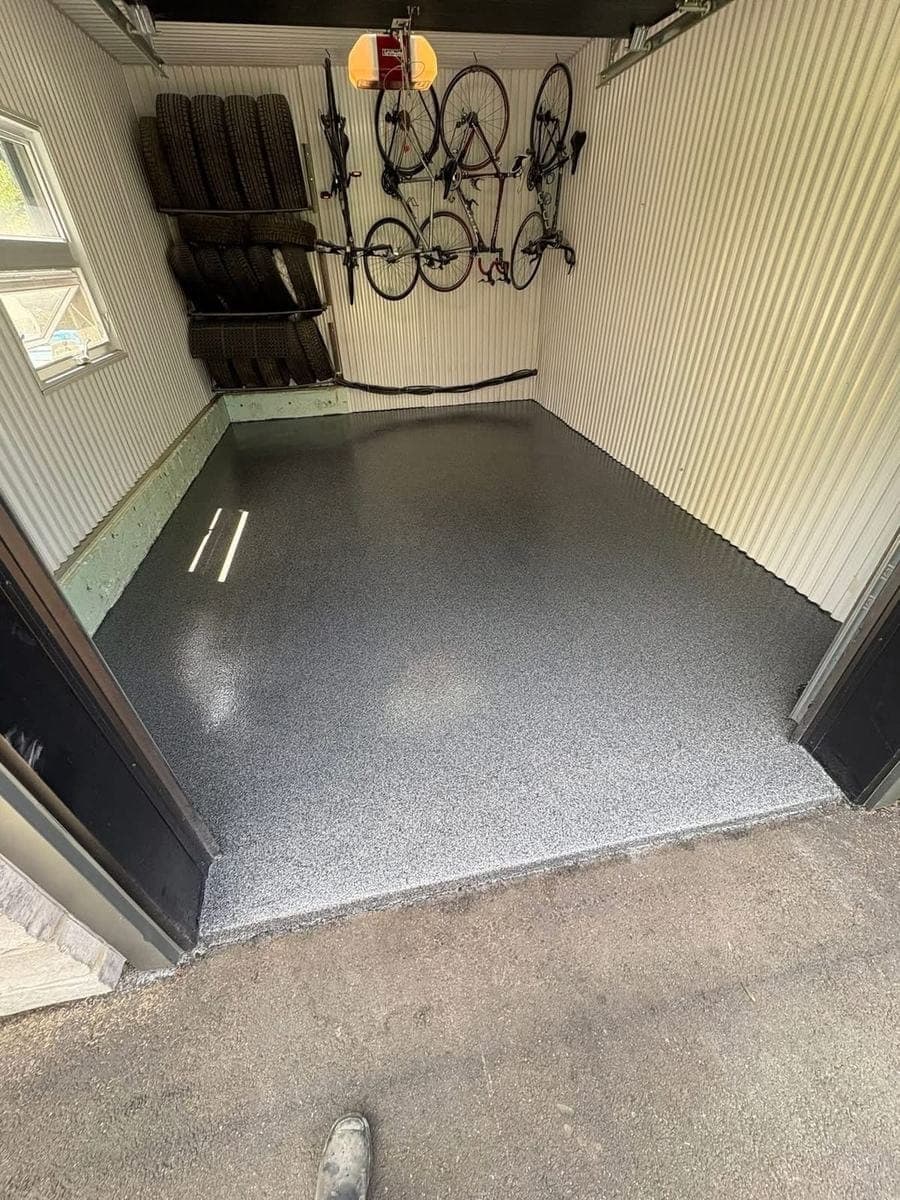
Epoxy or polyaspartic isn't really an either-or question. Epoxy bonds better to concrete and forms a solid base. Polyaspartic cures fast, resists UV rays and scratches. A floor that lasts a long time in Quebec usually combines both in the same system.
Epoxy and Polyaspartic: Two Materials, Not Two Rivals
A lot of people think you have to pick between epoxy and polyaspartic. In reality, in most well-built floor systems, the two work together.
Epoxy serves as the base. It penetrates diamond-ground concrete, bonds strongly, and gives the floor its body, whether you're adding vinyl flakes, a metallic finish, or double-broadcast quartz. Polyaspartic comes after, as the topcoat. It protects the epoxy from UV rays, scratches, and impacts, and it cures within hours instead of days.
So the real question isn't "which one replaces the other," but "which one does what" within a complete system.
Which Material Bonds Best to Concrete?
Epoxy wins this one. Its molecular structure lets it penetrate the pores of concrete after diamond grinding, creating a very strong mechanical bond. That's why almost every quality system starts with an epoxy base, even when the final finish is polyaspartic.
Polyaspartic, on the other hand, bonds well to an already prepared surface or over a layer of epoxy, but it's not designed to be the first point of contact with bare concrete. Used alone on unprepared concrete, its adhesion is less reliable, especially in a garage or basement where moisture and ground movement put the floor to the test.
The Downsides of an Epoxy Floor
Epoxy has real strengths, but you need to know its limits before deciding:
- It can yellow over time if exposed directly to UV rays without protection.
- It can become slippery when wet, especially with a smooth finish.
- Cure time is longer, which extends the project timeline.
- If poorly prepared (without proper grinding), it can peel or crack over time.
- It's more sensitive to residual moisture in the slab at the time of application.
That's exactly why a polyaspartic topcoat is applied over it in a complete system. It fixes the yellowing issue, improves scratch resistance, and gets the floor back in service much faster.
What Exactly Is Polyaspartic Coating?
Polyaspartic is a topcoat that belongs to the polyurea family. It cures very quickly, often within hours, which means a garage or a business can get back to using the floor much sooner than with epoxy alone.
It holds up well against UV rays, meaning no yellowing even on a deck or in a garage with large windows. It also handles temperature swings better, an important point in Quebec where a garage can go from minus 25 in January to over 30 in July.
Epoxy vs Polyurethane: The Real Difference
Epoxy coating and polyurethane coating (which includes polyaspartic) aren't in the same league.
Epoxy is more rigid and thicker. It gives the floor body and good abrasion resistance, but it's more vulnerable to UV rays and repeated thermal shock.
Polyurethane, and polyaspartic in particular, is more flexible. It flexes a little with the concrete slab without cracking, keeps its colour in the sun, and resists scratches from tires, tools, or de-icing salt tracked in on boots much better.
That's why a well-built system uses epoxy for the base and adhesion, then polyaspartic for surface protection.
What Actually Makes a Floor Last in Quebec
Our climate is tough on concrete and coatings: freeze-thaw cycles, calcium salt, thermal shock in an unheated garage. Three factors really make the difference between a floor that holds up for 10 years and one that peels after two winters:
- Diamond grinding done properly, no shortcuts, to open up the pores of the concrete.
- A complete system, epoxy base and polyaspartic finish, rather than a single coat.
- A crew that applies everything themselves, start to finish, without subcontracting that breaks the continuity of the work.
Whether your project is in Quebec City, Lévis, Saint-Georges, Beaupré, or Portneuf, these three elements are what determine how long your floor will hold up, far more than the brand of product used.
If you want to know which system suits your garage, basement, or warehouse, you can request a quote and we'll look at it with you based on the condition of your surface and how you plan to use it.
Related reading:
Frequently asked questions
Which material bonds best to concrete, epoxy or polyaspartic?
Epoxy bonds better directly to concrete because it penetrates the pores opened up by diamond grinding, creating a strong mechanical bond. Polyaspartic is generally applied over epoxy as a finish, not directly onto bare concrete. Époxy Québec Pro offers residential garage epoxy service.
What are the downsides of an epoxy floor?
Epoxy can yellow in the sun, become slippery when wet, and requires a longer cure time. If poorly prepared, it can also peel or crack over time, which is why proper grinding and a protective finish like polyaspartic matter so much.
What is polyaspartic coating?
Polyaspartic coating is a topcoat from the polyurea family that cures quickly, often within hours. It resists UV rays and scratches well, which makes it ideal as a protective layer over an epoxy floor.
What's the difference between epoxy coating and polyurethane coating?
Epoxy is more rigid and serves as the base for adhesion and floor body, but it holds up less well against UV rays. Polyurethane, which includes polyaspartic, is more flexible, keeps its colour in the sun, and better protects the surface against scratches.
Does epoxy or polyaspartic last longer in a Quebec garage?
Neither one really holds up on its own against the frost, salt, and thermal shock of a Quebec garage. It's the combination of the two, a properly ground epoxy base with a polyaspartic finish, that gives you the most durable floor.
Areas mentioned in this article