
Chemical-Resistant Garage Floor Coatings
September 4, 2026 · 4 min read
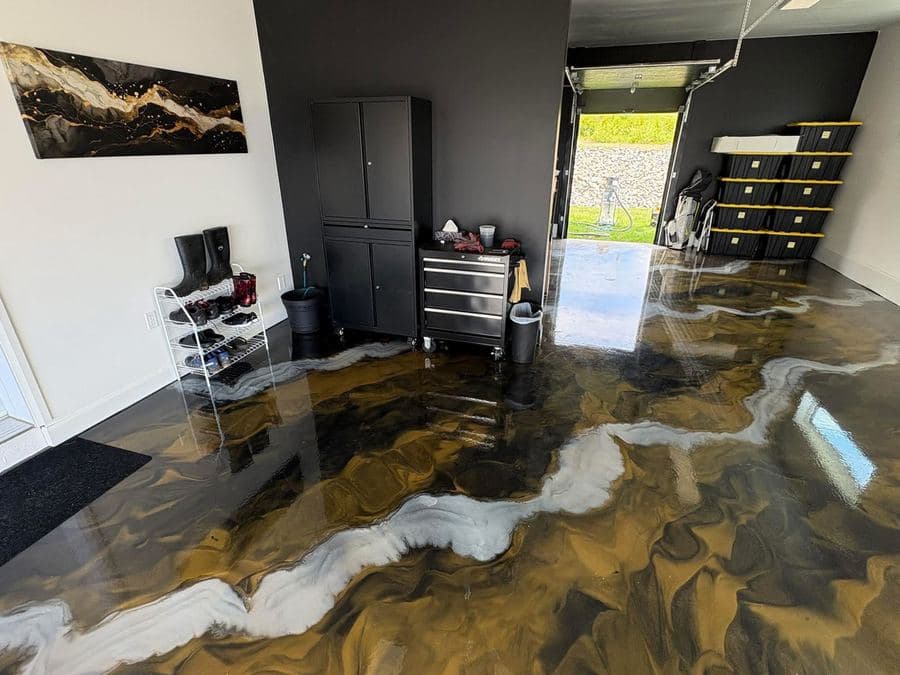
A chemical-resistant garage floor is one that won't react to motor oil, gasoline, brake fluid, antifreeze, or road salt. Here in Quebec City, with our winters, it's pretty much a must. A properly applied epoxy or polyaspartic system protects the concrete underneath and prevents permanent stains, cracking, and delamination.
Why bare concrete just doesn't cut it in a garage
Concrete is porous. A drop of oil or brake fluid left sitting on bare concrete eventually works its way into the surface. The result: a stain that no cleaner will ever fully remove. Add in the salt that gets tracked in under your car all winter and the moisture rising up from the ground, and the concrete starts breaking down over the years.
A properly done coating seals the concrete completely. Nothing gets through. Oil, salt, ammonia, household cleaners all stay on the surface and wipe away with a mop. That's the foundation of a floor that lasts decades without wearing out.
What actually gives a floor its chemical resistance
A floor's chemical resistance doesn't just come from the product that's applied. It comes from the prep work and the thickness of the system.
- Diamond grinding: this removes the surface laitance and opens up the pores in the concrete so the product actually bonds, instead of just sitting on top.
- Number of coats: a thin, single-coat system wears out fast under repeated exposure to fluids. A real multi-layer system holds up far longer.
- Polyaspartic topcoat: this is the finishing layer applied on top. It's what delivers chemical and abrasion resistance, and it cures faster than other finishes.
Here, the whole process, from grinding to the polyaspartic topcoat, is handled by our own crew. Nothing is subcontracted out, so we control the quality at every step of the way.
The three finishes and how they hold up to chemicals
- Vinyl flake: solid all-around resistance to common automotive fluids, with a clean look for a residential garage.
- Hand-poured metallic: same durable epoxy base, with a one-of-a-kind visual finish for anyone who wants a garage that looks as good as it performs.
- Double-broadcast quartz: the toughest of the three finishes, built for high-traffic surfaces like workshops or commercial garages exposed to oil, solvents, and cart traffic.
The right choice comes down to how the floor will actually be used: a residential garage doesn't have the same needs as a mechanic's shop or an industrial floor.
How long a chemical-resistant floor lasts
A properly installed and well-maintained system can last anywhere from 10 to 20 years, sometimes longer. That's why we back our floors with a 10-year warranty: when the job is done right, with proper prep and the right number of coats, the floor holds up.
Maintenance stays simple: wipe up spills quickly, sweep away salt and gravel, and wash as needed. No abrasive products required, the polyaspartic topcoat does the work.
What affects the price of a garage floor
There's no flat rate for a garage floor, because every project is different. Here's what factors into the price:
- The current condition of the concrete (cracks, moisture, old coating to remove)
- The total area to be covered
- The finish you choose (flake, metallic, or double-broadcast quartz)
- The amount of prep work needed before application
The only way to know what it'll cost for your garage is to let us take a look at the surface. Request your quote and we'll give you a real number based on your project, not some generic average.
Who this type of floor is for
Whether you're in Quebec City, Lévis, Saint-Georges, Beaupré, or Portneuf, if your garage, workshop, or warehouse sees oil, gas, salt, or cleaning products, a chemical-resistant coating changes the game. The same goes for businesses with floors exposed to solvents or mild acids.
If you want a floor that won't stain, won't peel, and won't crack over the years, fill out our quote form and let's take a look at your project together.
Related reading:
Frequently asked questions
What's the best type of coating for a garage?
For a garage exposed to oil, gasoline, and road salt, a multi-layer epoxy system with a polyaspartic topcoat offers the best combination of chemical resistance and durability. The exact choice between flake, metallic, or double-broadcast quartz depends on how the garage is actually used. Époxy Québec Pro also offers residential garage epoxy.
What does an epoxy garage floor cost?
The cost depends on the condition of the concrete, the square footage, the finish chosen, and the prep work needed before application. We can't give an honest general number without seeing the surface, so request a quote from Époxy Québec Pro for a real price based on your project.
What's the best floor coating for a garage?
A properly prepped epoxy system, with diamond grinding and a polyaspartic topcoat, remains the most reliable option for a garage. That's what gives you resistance to automotive fluids and salt without the floor peeling.
How long does an epoxy floor last?
A properly installed and well-maintained floor can last 10 to 20 years, sometimes longer. That's why we back our floors with a 10-year warranty when the job is done right. Époxy Québec Pro also offers quartz epoxy flooring.
Does an epoxy floor really hold up to road salt?
Yes, a properly sealed epoxy system holds up very well against the salt tracked in under your car during winter. The salt stays on the surface instead of soaking into the concrete, which prevents the crumbling typically seen in unprotected garages. Époxy Québec Pro offers hand-poured metallic epoxy flooring.
Areas mentioned in this article